The Rural Institute
Prototypes

Tools

We are prototyping a small set of instruments for the research — a mix of knowledge, research and synthesis tools. They exist because nothing off the shelf does the job. All of them are pre-alpha.

Pre-alpha — please read this first

These are not beta products. They are earlier than that. Pre-alpha means the research is running ahead of the software, and the software will at times show that.

  • Some features are not ready. Sections are unfinished, a few are visibly so, and interfaces change without notice.
  • You cannot sign up yet. There are no accounts. Where a tool appears to offer one, it will not work. We know that is frustrating, and we would rather say so here than let you find out three clicks in.
  • A tool may be offline while we are working on it. If you’ve grown to depend on any of the tools, please let us know.

What is solid is the part that matters most: the data. Every corpus behind these tools is real, compiled from primary sources, and rigorously verified before anything is built on top of it. The core functionality — search, retrieval, comparison, the analytical views — is robust and in daily use by the research. It is the product around it that has not been built. Work is ongoing and we will continuously be improving and adding to these tools. Please do reach out if you'd like to discuss them or have any interest in collaborating on current or new tools.

Treat them as research instruments, not as services. Everything here is provided as an experiment and as-is; see the terms of use.

Knowledge tools

Corpora that did not exist in one place

Each of these gathers primary material that is otherwise scattered across agencies, funders and PDFs, verifies it, and makes it searchable. Helping to provide valuable information, data, insights, answers to questions, and other people's learnings. All to help and support the future of rural revitalization.

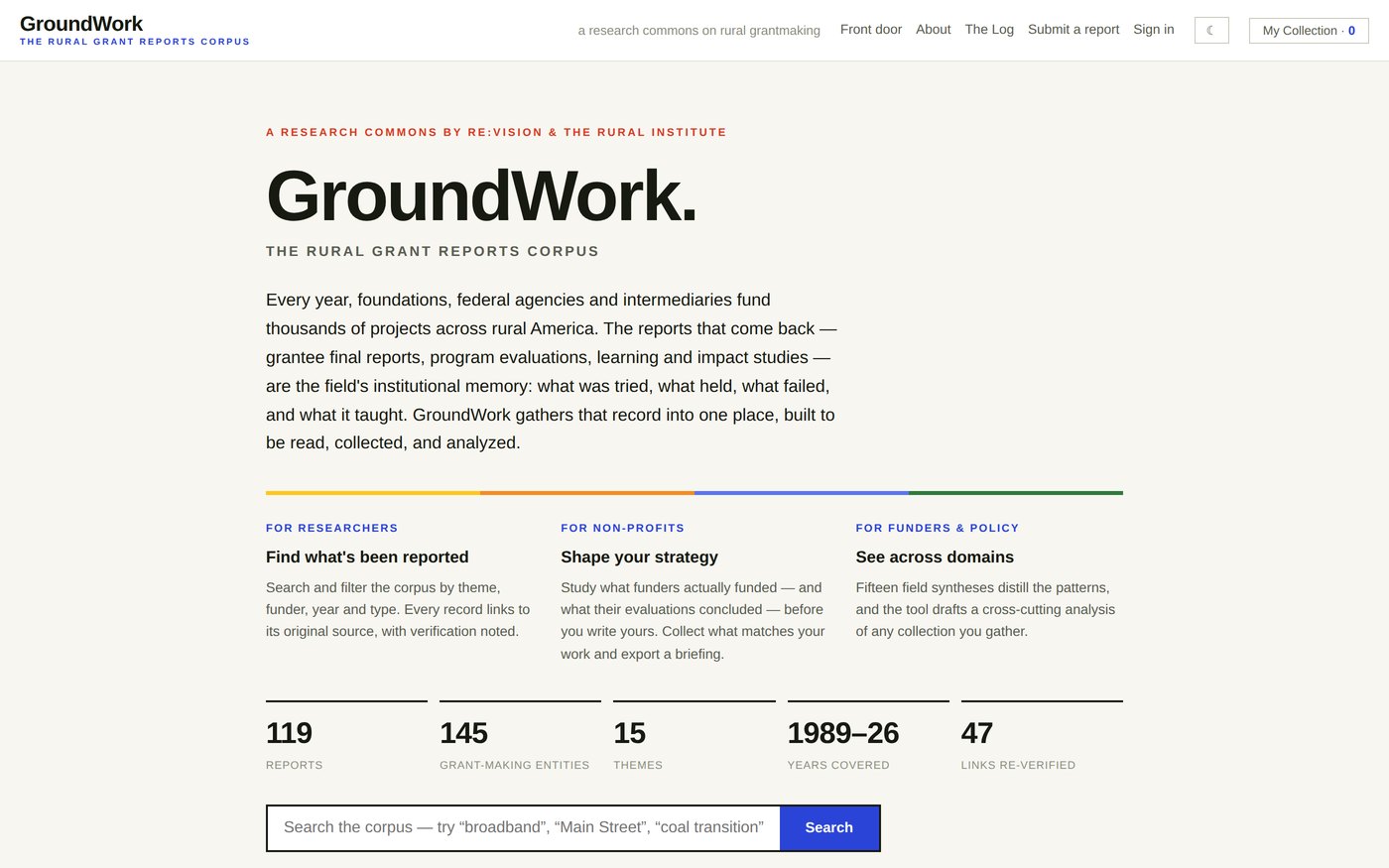
The GroundWork interface, showing the rural grant reports corpus.
Knowledge · Corpus

GroundWork
Rural Grant Reports Corpus

A verified corpus of rural grant reporting: who funds rural work, what they asked to be reported, and what the reports actually say. Built because funder practice in rural regions is documented almost entirely in documents nobody has ever read side by side.

  • In the corpus145 funders · 119 reports · 15 themes
  • ProvenancePrimary source documents, verified on entry
  • StatusPre-alpha · no accounts · open
Open GroundWork →
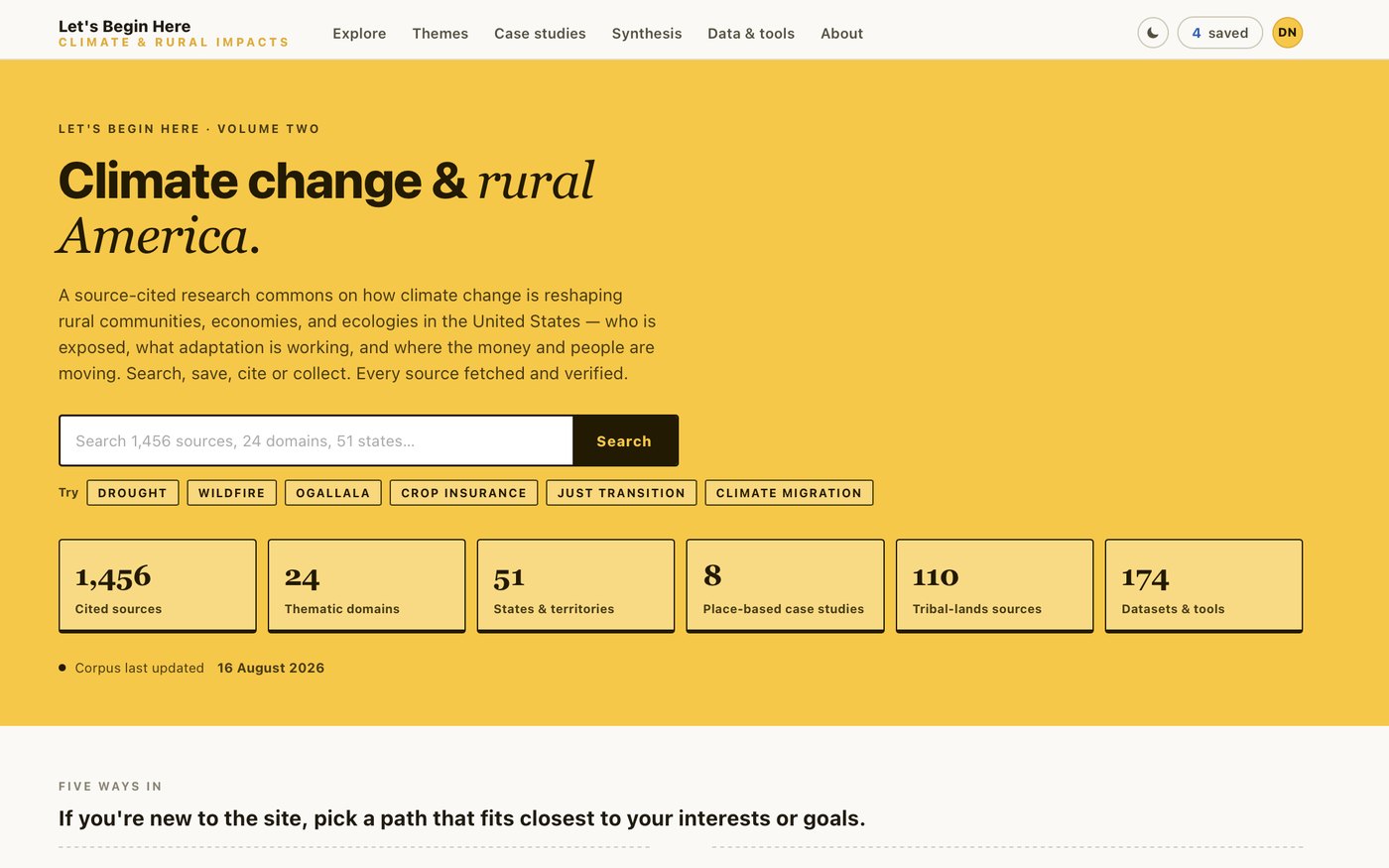
Let's Begin Here: Climate & Rural Impacts, showing the evidence commons.
Knowledge · Corpus

Let's Begin Here
Climate & Rural Impacts

An evidence commons on climate hazards and their rural consequences, assembled from primary literature and agency sources. It was built partly to measure its own gap: rural places carry a disproportionate share of climate exposure and a fraction of the research attention, and the corpus makes that asymmetry visible rather than asserting it.

  • In the corpus1,456 sources · 24 domains · 51 states and territories
  • ProvenancePrimary literature and agency sources, verified on entry
  • StatusPre-alpha · no accounts · open
Open Climate & Rural Impacts →
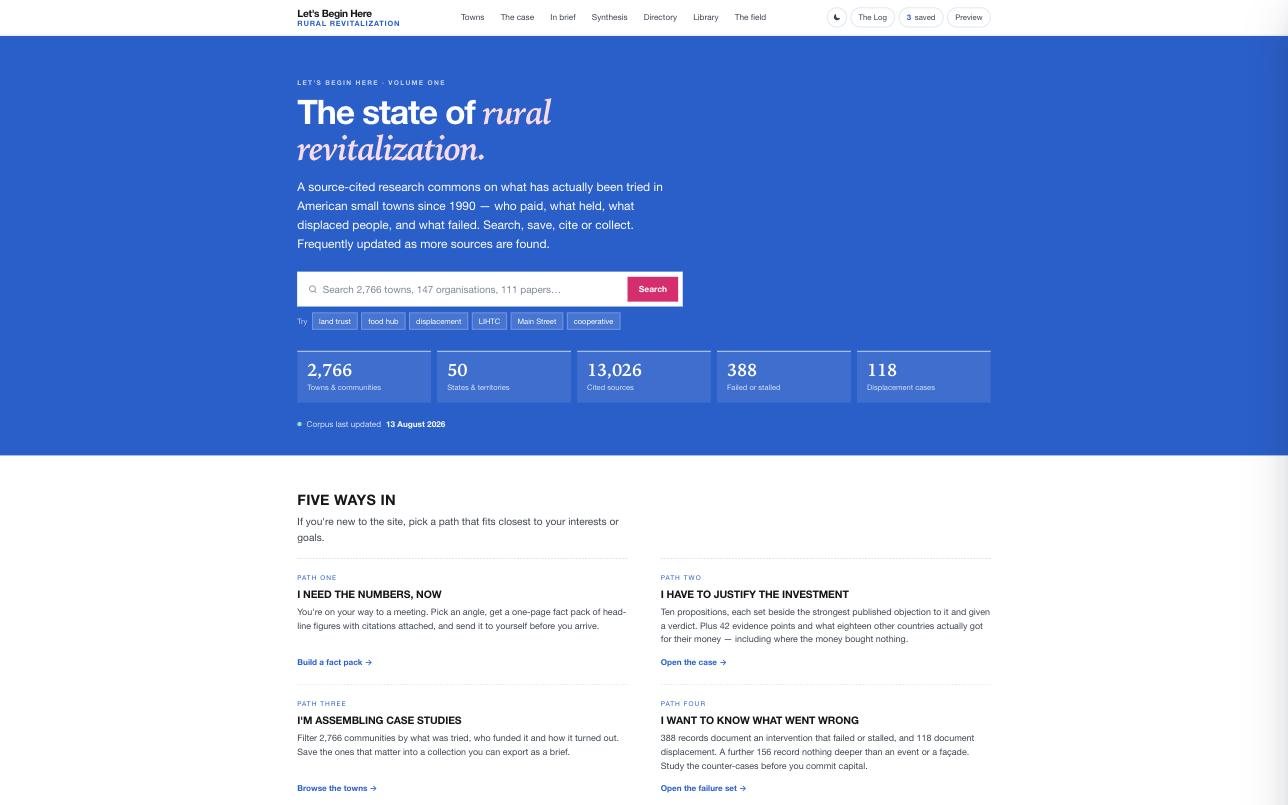
Let's Begin Here: Rural Revitalization.
Research · Corpus

Let's Begin Here
Rural Revitalization

The companion corpus on revitalization practice — what has been tried in rural towns, by whom, with what reasoning, and what was reported afterwards. It supplies the framing the Institute uses when a town asks the reasonable question: has anyone done this before, and how did it go?

  • ProvenancePrimary source practice literature, verified on entry
  • AccessBehind an access gate — you will meet a login
  • StatusPre-alpha · no public sign-up
Open Rural Revitalization →
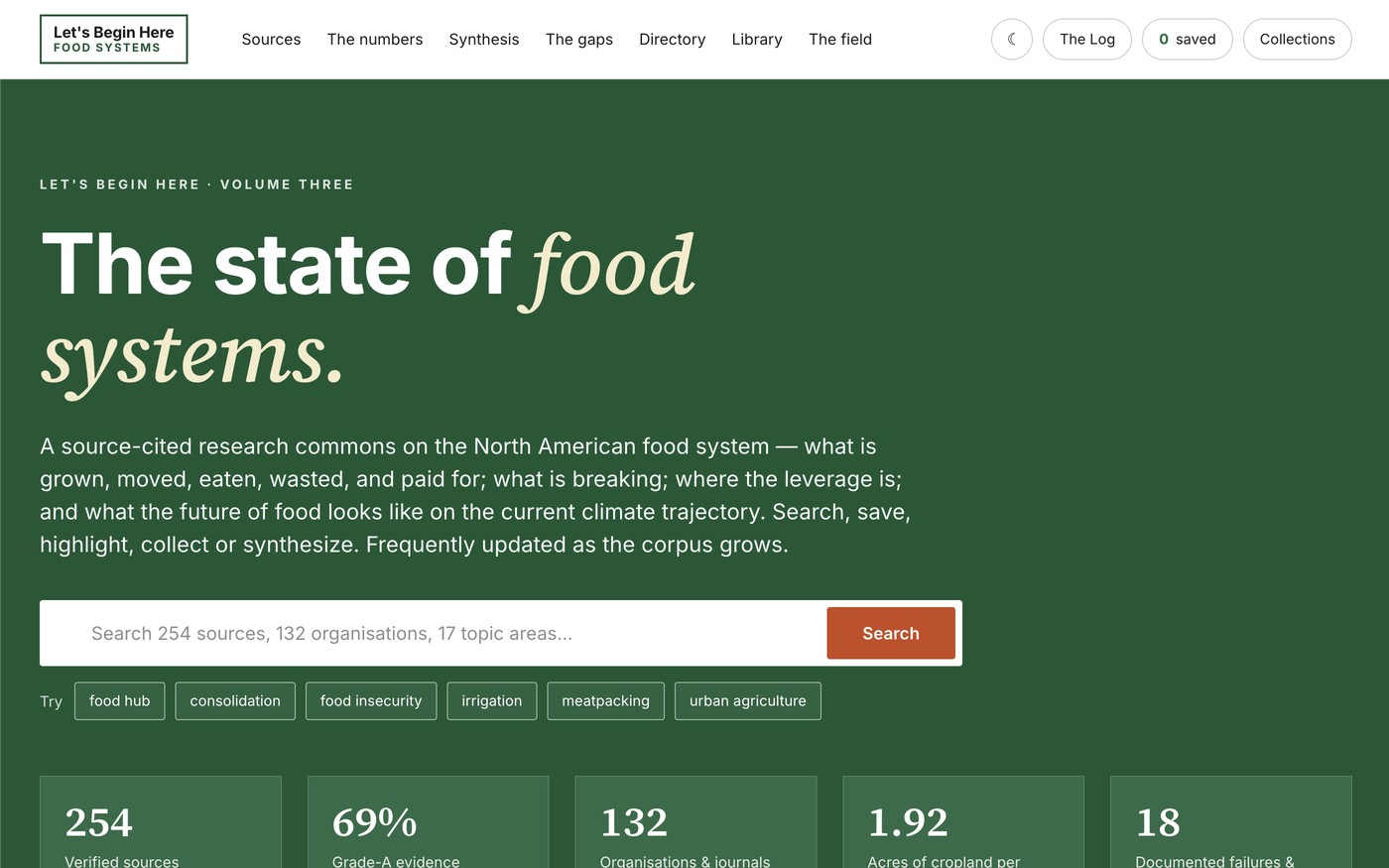
Let's Begin Here: Food Systems, showing the research commons.
Knowledge · Corpus

Let's Begin Here
Food Systems

A source-cited research commons on the North American food system — what is grown, moved, eaten, wasted and paid for, what is breaking, and where the leverage is. The largest of the corpora, and the one that most deliberately documents its own blind spots: pesticide data stale since 2012, food-system energy figures frozen at the same year, grantee outputs that could not be located. For a funder, each gap is a candidate for support.

  • In the corpus254 verified sources · 132 organisations and journals · 4 domains
  • ProvenancePrimary sources graded on a public rubric; 69% peer-reviewed or federal data
  • StatusPre-alpha · no accounts · open
Open Food Systems →
Synthesis tools

Turning field material into something a town can use

Where the knowledge tools gather, these two read across field work, records and corpus evidence at once. Both are internal instruments, shown here for completeness rather than for use.

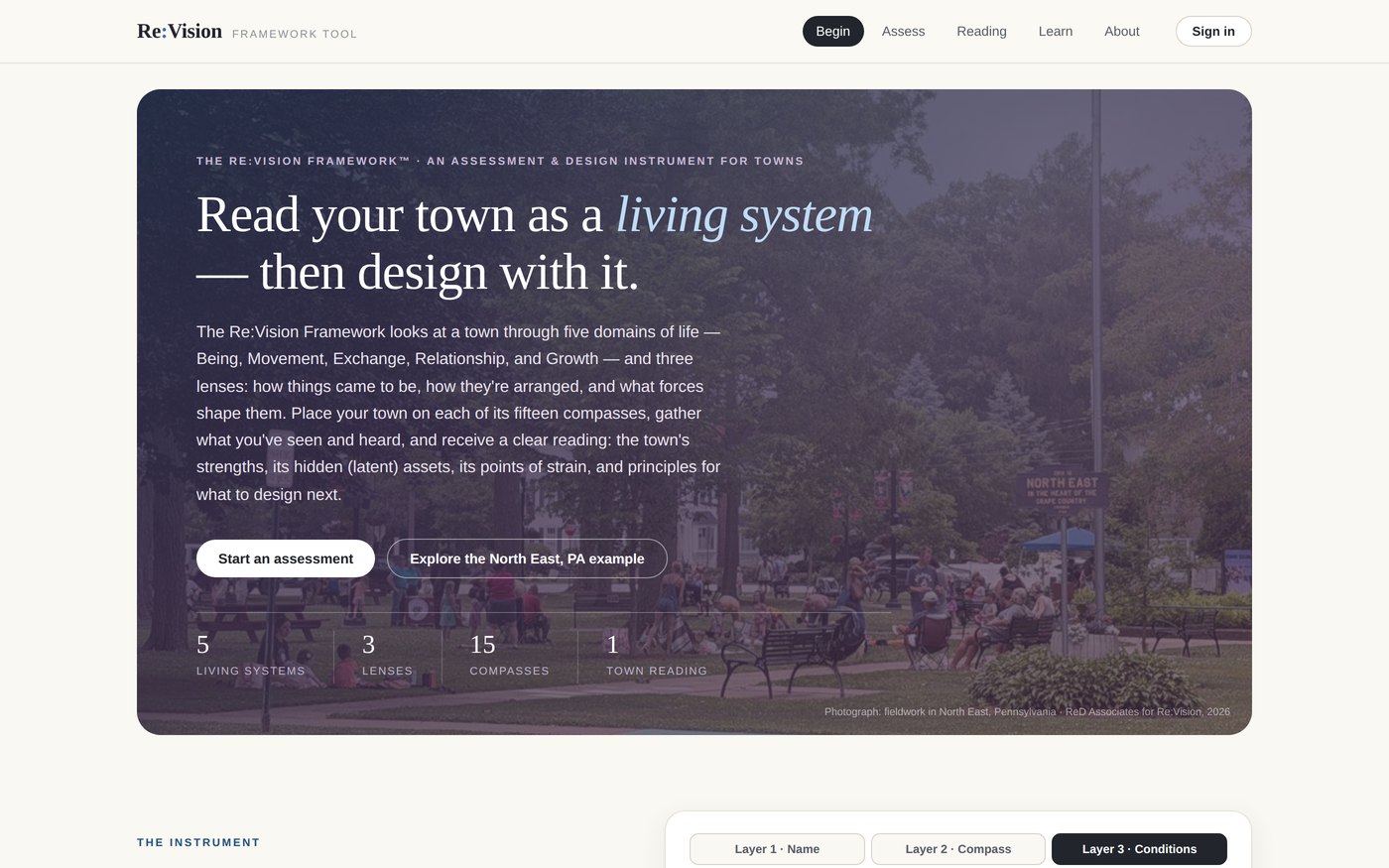
The Re:Vision Framework Tool, showing domain readings.
Synthesis · Assessment

Re:Vision Framework Tool

The instrument behind the Framework assessment: five domains, read across a set of faceted positions, each with an explicit confidence level and the field evidence that produced it. It is deliberately not a score. The point is to make an assessment legible and contestable — a town can see why a reading was made and disagree with it in the open.

  • Live readingNorth East, Pennsylvania — real field data
  • ProvenanceField work by Re:Vision with ReD Associates
  • AccessInternal use only
  • StatusPre-alpha · not publicly available
Internal use only
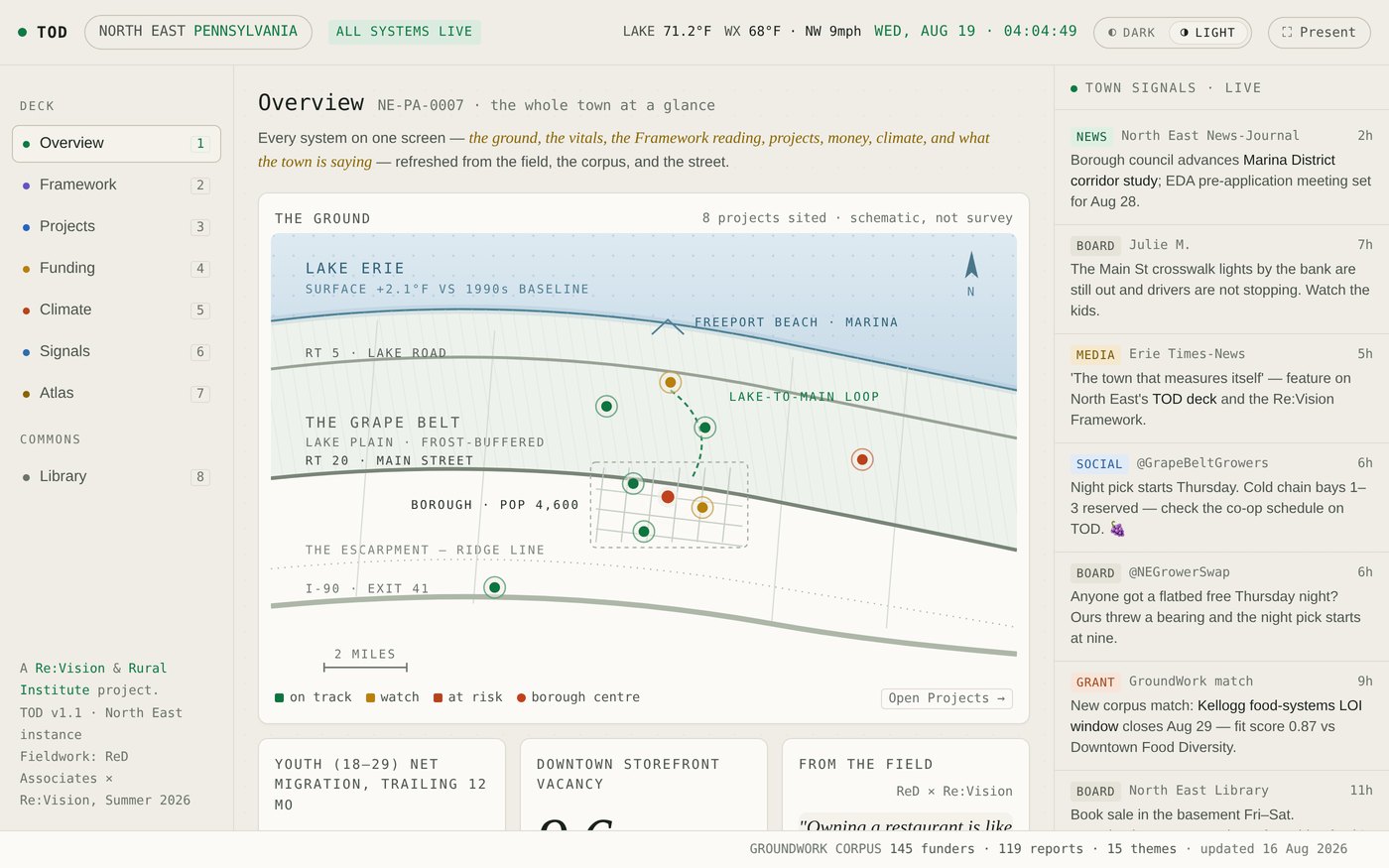
TOD, the Town Operating Dashboard.
Synthesis · Concept demonstrator

TOD
Town Operating Dashboard

A working demonstrator of what a town's own operating instrument could look like if the corpora, the Framework and a project pipeline were read in one place — assessment, funding routes, climate exposure, projects and signals on a single deck. North East, Pennsylvania is the worked example.

A note on its data. TOD is the one item here that is part demonstration. Its Framework reading and its corpus panels draw on the real, verified data above; its town vitals, project list and funding pipeline are illustrative, used to show the shape of the instrument rather than to report on the town. It is labelled as such inside the tool.

  • RealFramework reading · corpus statistics · funder records
  • IllustrativeTown vitals · projects · pipeline figures
  • AccessInternal use only
  • StatusPre-alpha · desktop only · not publicly available
Internal use only

Using these in your own work

If a corpus or a tool is useful to your research, you are welcome to it — with the caveats above taken seriously. If you are using one and would like to collaborate on specific features or functionality for your organization, please do connect with us. Or if you have a tool you'd like developed for your work, we'd also like to hear from you. If something is broken, that is also genuinely useful to hear.

hello@theruralinstitute.org